
Try it with MononoMori
In MononoMori, record expiry dates for what's stocked in your kitchen, medicine box and vanity, and let Falling Leaves remind you before things expire.
Storage Guides
Forest Editorial 6 min read
Hello everyone, I’m Windmori.
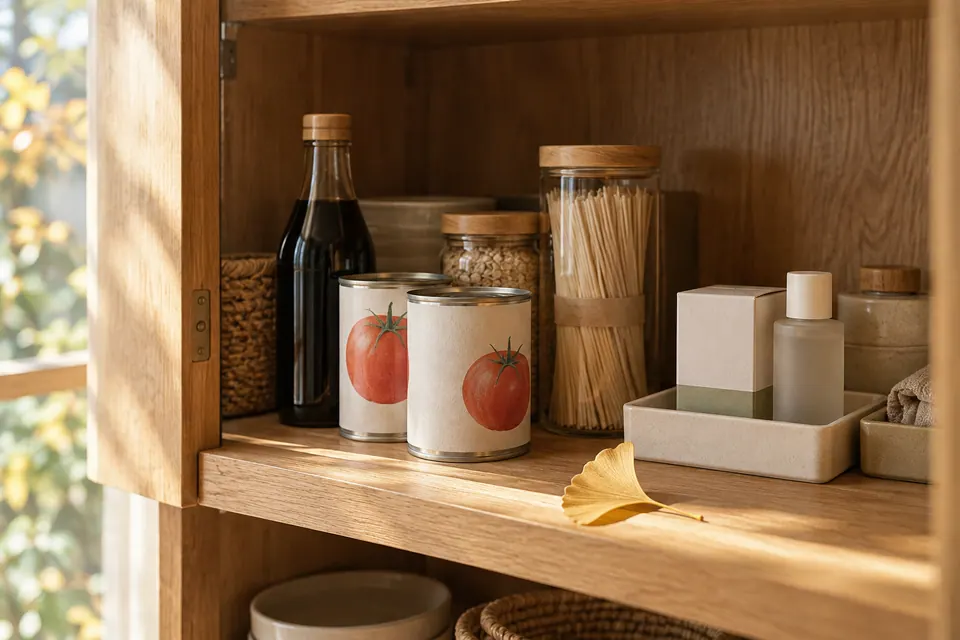
A few days ago I wanted to make braised pork belly. The soy sauce by the stove was nearly empty, so I opened the top cupboard, and there was an unopened bottle.
I was pleased, until I looked at the label: its best-before date had passed this spring.
Further back, a packet of noodles I’d stocked up on last year and two cans of tomatoes bought on sale were also past their dates. When they came home, every one of them was meant to be “just in case.”
This isn’t one person’s carelessness. Figures from Japan’s Consumer Affairs Agency put household food loss in Japan at about 2.33 million tonnes in fiscal year 2023. Medicine is no different: a survey of more than four thousand people in Australia found that six in ten kept medicine at home “just in case,” and about a third of those medicines had expired.
From an organizing point of view, things usually don’t expire because they “went bad.” They expire because they were forgotten:
So the question isn’t whether to stock up. It’s whether you’ll remember what you’ve stocked before it expires.
When you add food, medicine or skincare to MononoMori, enter the date on the package as its “Expiry Date.” As soon as that field has a value, the reminders described below start working on their own.
If you have several of the same thing with different dates (say, milk bought on two separate trips), it’s best to record them as two items, so each one has its own date.
When you bring home a lot of things from the same batch, long-press to select them in “Items,” open “Batch Actions,” and use “Expiry” to give them all the same date at once.
In the “Expiry Reminder” settings you can turn on three reminders separately: “One week ahead,” “Three days ahead” and “One day ahead.” All three are on by default. The “Reminder Time” is 9 a.m. by default, and you can change it to whenever suits you better, such as just before you leave work or before your grocery run.
Reminders rely on iOS notification permissions. If you’ve never received one, check in your iPhone’s Settings that notifications are turned on for MononoMori.
Tap an expiry reminder and you’ll land in “Falling Leaves.” Here, items that have expired or are about to are lined up in a single list, and you can decide on each one right there:
There’s no need to open each item’s detail page. In a few minutes you can see to a whole cupboard’s worth of “falling leaves.”

In MononoMori, record expiry dates for what's stocked in your kitchen, medicine box and vanity, and let Falling Leaves remind you before things expire.
My own habit: before the weekend grocery run, I open “Expiring Soon” and take a look. A can of tomatoes close to its date decides that week’s menu.
You don’t need to record every bag of snacks in the house. Pick the one place where things most often expire:
Record the dates for what’s in that one place. The first time Falling Leaves helps you use up something just before it expires, you’ll see why it’s worth doing.
If you’d like to turn your medicine box into a checklist you can go through item by item, have a look at Baskets and Checklist Mode from Vol. 2 of this series.
In the end, I poured that expired soy sauce away.
But since that day, every new bottle in the cupboard has its own date. A few days ago, MononoMori reminded me that a packet of noodles had three days left, and that night we had a big pot of hot noodle soup.
When the things we stock up on get used up properly, that’s probably the best way to honor them, and the “just in case” care we bought them with.
Which cupboard in your home is most likely to hide something expired?
Hope today’s Life & Features issue brings a spark of inspiration to your organization journey.
See you next time in the forest. 🌿
 Storage Guides You Already Had One, and Bought Another: Making "Check Before You Buy" a Habit with Locations and Search Life & Features Vol. 6: Things get put away and then can't be found, or you get home with something new only to find its twin in a drawer. Almost every household has been there. This issue looks at why we end up buying duplicates, and how MononoMori's groves, locations, photos and search let you ask one question before paying: do I already have this at home? 6 min read
  Storage Guides What's Actually in That Box? Settling Seasonal and Moving Boxes with Sub-locations and Hibernation Life & Features Vol. 8: Clothes sealed into a box at the change of season are forgotten by the next year; moving boxes, neatly labeled, sit unopened for months. Starting from seasonal swaps and moving house, this issue looks at how MononoMori's sub-locations, Hibernate and Transplant let every box tell you what's inside. 7 min read
  Storage Guides The Hardest Part of Emergency Kits Isn't Day One—It's Years Later: Organizing Life's Preparedness with Baskets Life & Features Vol. 2: Preparing emergency disaster supplies isn't the hardest part—maintaining their status over time is. Exploring the logic of order and readiness behind MononoMori's Basket feature across disaster prep, camping, and travel. 6 min read