Try it with MononoMori
Enable Story Chronicles in MononoMori to organize cherished memories by life stages, rediscovering the warmth of bygone days.
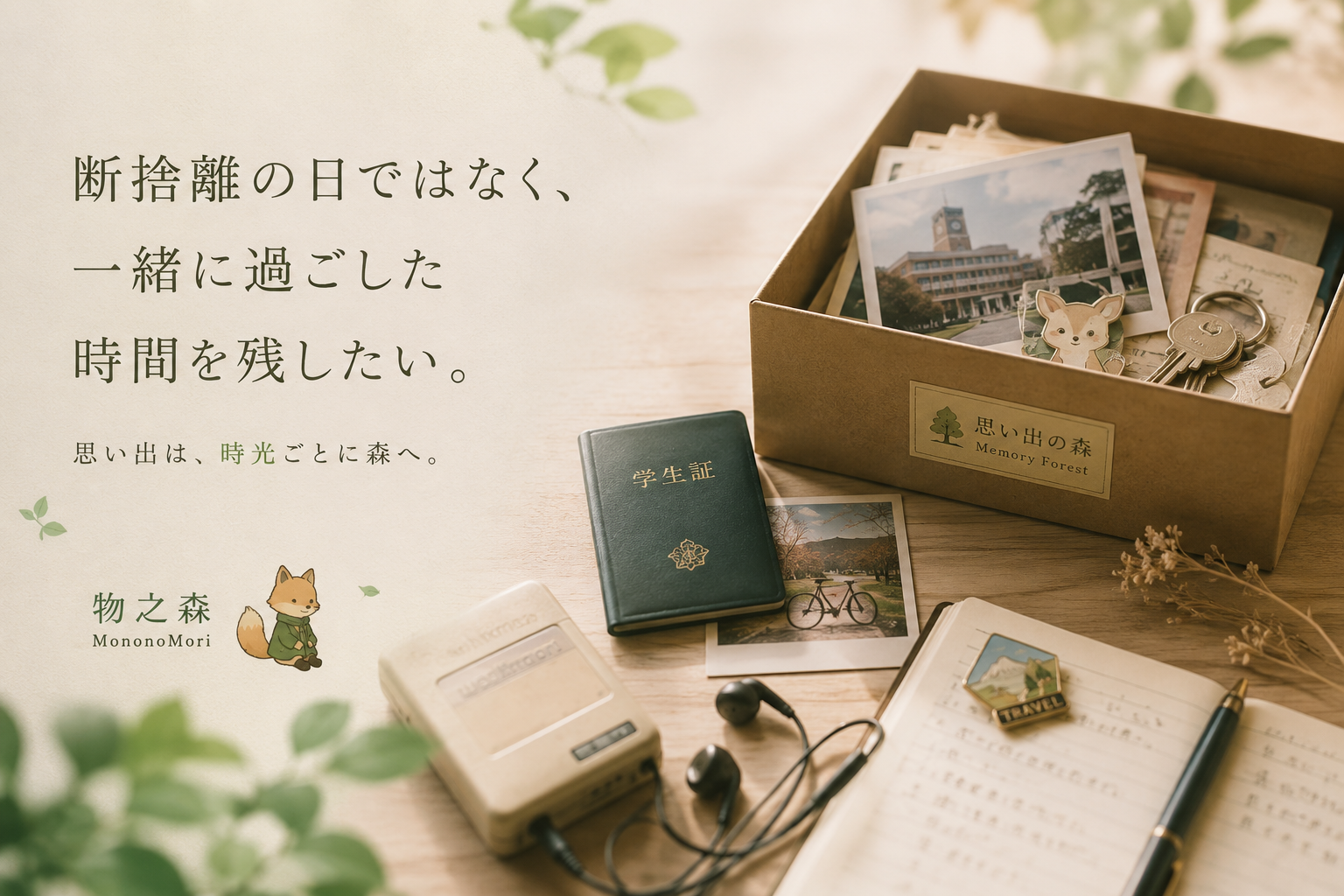
Have you ever found yourself in a moment like this?
You’ve resolved to do a thorough decluttering. You pull open a desk drawer, ready to clear out the long-forgotten items gathered inside. But the second your hand touches a particular object—a book with slightly yellowed pages, a dried-up gel pen, a student ID bearing a youthful photo, or a metal keychain with faded brass plating—your movement suddenly halts.
You hesitate, and gently lay it back down on the table.
We hesitate to let go not because the item still holds functional utility today, but because it once accompanied us through a specific chapter of our lives.
As a proponent of home organization and mindful living, friends often ask me: “Windmori, does decluttering mean being cold-hearted and throwing everything away?”
Of course not. The true essence of organization is clarifying our relationship with items, rather than blindly pursuing minimalism or empty rooms. Those old belongings carrying memories of youth, friendship, or a particular state of mind are integral parts of our personal journey.
Tossing them directly into the trash brings a subtle sting of guilt; yet keeping them crammed in drawer corners leaves our physical space forever weighed down.
That is why many people choose a middle ground: taking a quick photo, writing a short note, and then peacefully saying goodbye to the physical object.
This is the original inspiration behind MononoMori’s Memory Forest—allowing decluttered belongings to retire into a digital forest, leaving physical space for the present while preserving warm memories for the future.
In early versions of the Memory Forest, all items entered the forest in simple chronological order based on when they were decluttered—from newest to oldest.
Until one day, a MononoMori user sent an email that deeply moved me:
“Windmori, today I finally let go of my college club photo album. But when I opened the Memory Forest, it was listed right next to a broken electric fan I threw out last week, both dated July 2026. But that album belongs to my college summer of 2018… Looking at that deletion date didn’t feel heartwarming; it just reminded me that I had thrown away another piece of my past.”
That feedback forced me to re-examine the emotional dimension of our possessions:
What truly represents an object’s place in our story was never the day we decided to toss it away, but the era when it quietly walked beside us.
If we only sort memories by their “erasure date,” the Memory Forest becomes little more than a receipt book of discarded things. And that goes against everything we stand for.

Enable Story Chronicles in MononoMori to organize cherished memories by life stages, rediscovering the warmth of bygone days.
To solve this dilemma, we introduced a brand-new feature: Story Chronicles.
Now, when items enter the Memory Forest, you no longer passively watch them stack up by deletion date. Instead, you can freely craft your own life timeline:
You can create chapters such as “Elementary Days,” “High School Memories,” “College Years,” or “First Few Years at Work.” Simply drag student IDs, old journals, or club badges back to the era where they were born.
Memories aren’t defined only by age. You can also build chapters based on “Days in Tokyo,” “Memories of My First Startup,” or “Summer of 2023.”
When you place an old item into a specific Story Chronicle, its identity transforms: it is no longer “discarded clutter,” but a treasured keepsake in your life album.
We can look at this organization experience through two lenses:
From a Storage Expert’s Perspective (Rational Order):
Traditional “emotional decluttering” often lacks visual and structural support. Story Chronicles provides a structured memory archiving framework. By granting specific life dimensions to memories, users can complete a mindful “handover ritual,” eliminating the guilt associated with letting go.
From an Everyday User’s Perspective (Sensory Warmth):
Years from now, when you open Story Chronicles · College Years, old guitar sheets, club pins, and flight stubs from graduation trips will gently reappear. You won’t see a random pile of old photos, but a complete, authentic version of who you once were.
In that instant, it feels as if those items are walking you right back to that glowing moment in time.
Life moves forward, and we cannot carry every physical object in our backpacks. But as long as memories have a sanctuary to rest, decluttering is no longer a painful parting—it becomes a gentle milestone of reflection.
If it were you, how would you organize these memories? By life stages, seasons, cities, or a milestone moment in your journey?
Hope today’s Design Notes story brings a spark of inspiration to your organization journey.
See you next time in the forest. 🌿
Record every item, build your sanctuary. Turn tidying into a healing ritual.
Get MononoMori for Free
Life & Function Series #4: The hardest part of decluttering is never discarding—it is the fear that past days will vanish with the object. Exploring the emotional psychology of farewell rituals and how MonoMori's Memory Forest shelters our cherished belongings, journeys, and life chapters.

Life & Features Vol. 3: Certain items remain by our side simply because of years of quiet companionship. Exploring the emotional value and lifecycle logic behind MononoMori's Tree Rings feature.

Life & Features Vol. 2: Preparing emergency disaster supplies isn't the hardest part—maintaining their status over time is. Exploring the logic of order and readiness behind MononoMori's Basket feature across disaster prep, camping, and travel.