
Try it with MononoMori
Enable "Tree Rings" for your most cherished possessions in MononoMori, capturing every footprint and watching memories bloom over time.
Item Stories
Forest Editorial 6 min read
Hello everyone, I’m Windmori.
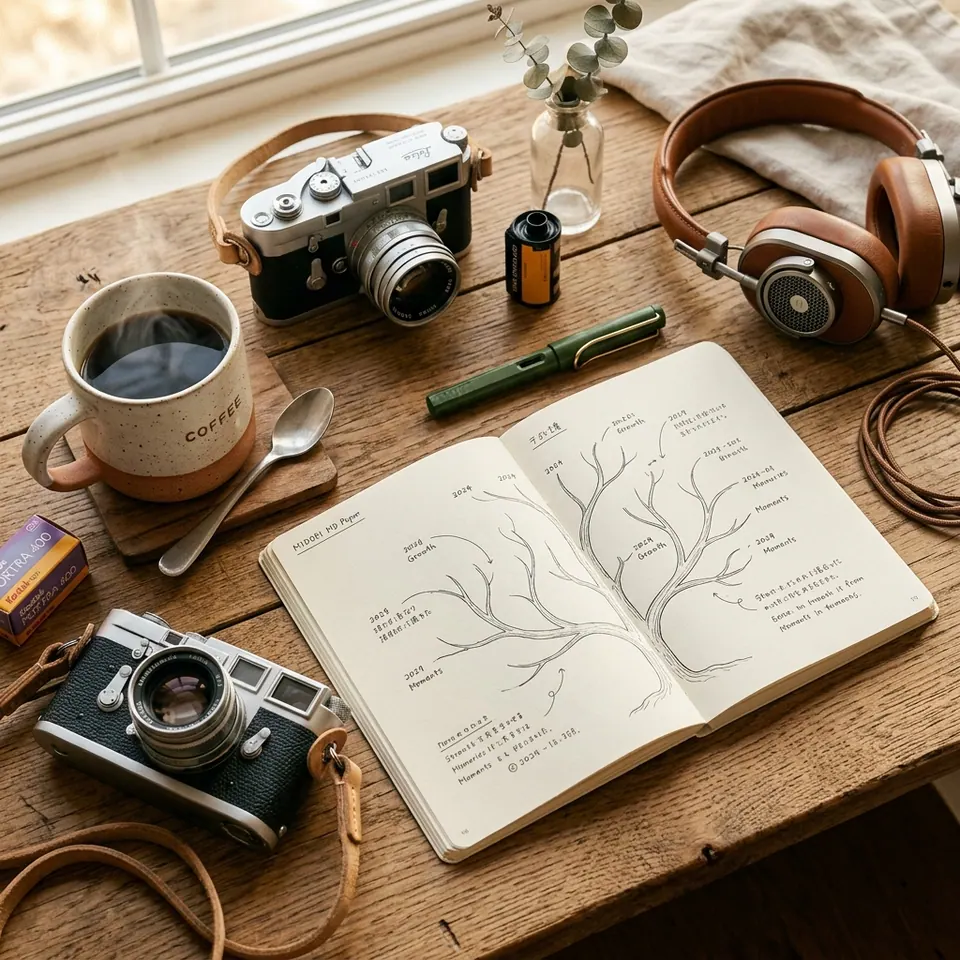
Look around your home—do you have a few items like this?
They might not be luxury designer goods. In fact, their surfaces might carry subtle scuffs and wear from years of use. Yet every single time you tidy your room, you unhesitatingly place them right back into the most accessible spot.
For instance:
We use them every day. They moved with us from old apartments to new homes, got lent to close friends, and stood by us through life’s triumphs and low points.
Before you know it, an item is no longer just a cold physical object—it has become a quiet witness to your life’s journey.
In many home organization or budgeting apps, evaluating an item boils down to a few dry figures: original purchase price, depreciation rate, and current resale value.
Under that strictly financial logic, every item you buy starts “depreciating” the moment you unbox it. Over time, our relationship with possessions turns into cold accounting—we get trapped in calculating “How much money did I spend?” or “What is my cost per use?”
Yet from a home organization and psychological perspective, overly analytical math severs our authentic emotional bond with our belongings.
You cherish that three-year-old mug not because “each cup of coffee calculated down to pennies,” but because of the comforting warmth felt whenever your hand wraps around its ceramic body.
That’s why I kept reflecting: What if the movements, uses, and creative sparks an item shares with us could all be recorded together? Wouldn’t organizing our lives feel so much warmer?
Just as ancient trees carve years of rain and sun into growth rings, a cherished item develops its own growth rings beside you.
In MononoMori, we named this lifecycle-tracking feature “Tree Rings”.
Rather than a static property list, Tree Rings is a dynamic timeline that gently expands over time:
Whenever you use an item—whether completing a photo shoot with your camera or finishing a journal entry with your fountain pen—you can tap “Check In” on its timeline in MononoMori to leave a tiny footprint.
No cumbersome logging rituals required; a simple tap adds a new, subtle ring of growth to its history.
With “Note,” you can jot down short reflections on the timeline whenever inspiration strikes or after an item returns from being lent out.
For example: “Summer 2024, brought it on a beach trip,” or “Lent to Alex for a week; returned it with a bottle of my favorite ink.”
When an item moves from your desk to a bedside shelf, or travels across cities during a move, updating its storage location automatically weaves these spatial journeys into its timeline.

Enable "Tree Rings" for your most cherished possessions in MononoMori, capturing every footprint and watching memories bloom over time.
Open the full timeline and two numbers greet you first: how many days you have been together, and how many check-ins you have logged.
If you log an item’s purchase price, a third appears beside them: “Cost/Use,” the price divided by your check-ins. It never coldly announces that “your cost has been amortized”; it simply drifts lower each time you check in. Watching it, thoughts like these tend to surface:
“Look, this fountain pen has walked beside you 412 times."
"Reflecting on it, every single use carries deep, quiet value.”
Seen from that angle, the same price turns anxiety-driven accounting into gratitude for life’s quiet companions.
When you realize a tool you hesitated to buy three years ago has supported you hundreds of times, you don’t feel buyer’s remorse—you feel a profound sense of satisfaction knowing “I’m so glad I bought it; it has served me so well.”
We can look at the Tree Rings experience through two complementary lenses:
From a Storage Expert’s Perspective (Rational Order):
Traditional organization focuses heavily on physical placement and resetting clutter. Tree Rings introduces lifecycle management across time. By visualizing usage footprints, it helps us distinguish true long-term companions from impulse buys left forgotten in drawers, discouraging wasteful consumption at the source.
From an Everyday User’s Perspective (Sensory Warmth):
Tree Rings tracks more than an object’s lifespan—it records the days you walked together. Years down the road, looking back at an old item’s timeline, those dense little nodes trace out the steady, authentic steps of your own life journey.
Objects have no voice, yet human care and daily use endow them with a unique soul.
Those quiet companions that stay by our side wrap our everyday lives in comfort through their reliability and familiarity.
Looking around you today, is there an item that still quietly walks beside you? How long has it been on this journey with you?
Open MononoMori, plant its first “Tree Ring,” and gently gather up those warm memories scattered across time.
Hope today’s Life & Features issue brings a spark of inspiration to your organization journey.
See you next time in the forest. 🌿
 Item Stories Three Years Living Alone: The 30 Items That Stayed Reflecting on the 30 most essential, beloved personal belongings that survived a rigorous decluttering journey. Discover the connection between order and mental clarity. 5 min read
 Storage Guides The Expired Soy Sauce at the Back of the Cupboard: Using Expiry Reminders and Falling Leaves So Your Stock Doesn't Go to Waste Life & Features Vol. 7: We stock up for peace of mind, and then find it all expired when we finally dig it out. Why do food, medicine and skincare quietly expire at the back of the cupboard? Drawing on MononoMori's Expiry Date, Expiry Reminder and Falling Leaves, this issue looks at how to remember what you have before it's too late to use it. 6 min read
 Storage Guides You Already Had One, and Bought Another: Making "Check Before You Buy" a Habit with Locations and Search Life & Features Vol. 6: Things get put away and then can't be found, or you get home with something new only to find its twin in a drawer. Almost every household has been there. This issue looks at why we end up buying duplicates, and how MononoMori's groves, locations, photos and search let you ask one question before paying: do I already have this at home? 6 min read